Descending Triangle Pattern
The Descending Triangle is a bearish continuation pattern formed by a flat horizontal support line and a falling resistance trendline. Price makes lower highs while repeatedly testing the same support level. The pattern signals that sellers are becoming more aggressive (stepping in at lower prices) while buyers hold a fixed level — eventually sellers win and price breaks down below support.
Ideal Pattern Diagram

Real Chart Examples
The following charts show the Descending Triangle Pattern as it appears on market data. Note how real-world examples may look slightly different from the ideal diagram.


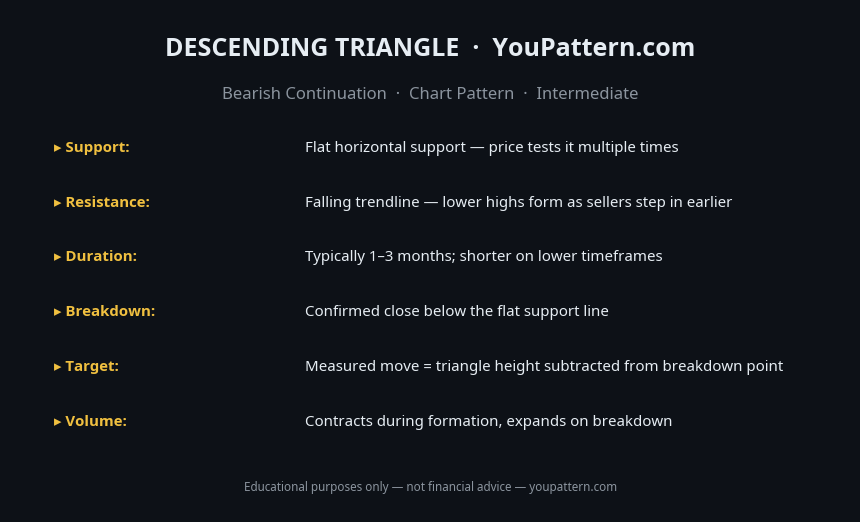
Quick Reference Cheat Sheet

Download the Descending Triangle Pattern Cheat Sheet
Save the quick-reference card as an image. Keep it open while you scan charts.
What Is the Descending Triangle Pattern?
The Descending Triangle is a bearish chart pattern characterised by a flat lower support line and a falling upper trendline. Price makes a series of lower highs while repeatedly testing the same support level, creating a triangle shape that converges toward the right. The pattern typically resolves with a breakdown below the support line.
The Descending Triangle is primarily a continuation pattern — it most commonly forms during a downtrend as a consolidation before the trend resumes. The pattern signals that sellers are becoming progressively more aggressive (lower highs), while buyers are consistently defending the same support level. Eventually, the selling pressure overwhelms the support and price breaks down.
How to Identify the Descending Triangle Pattern
To qualify as a valid Descending Triangle, the pattern must meet the following criteria:
- Flat lower support line: At least two (ideally three or more) price lows at approximately the same level, forming a horizontal support line.
- Falling upper trendline: At least two (ideally three or more) lower highs, forming a downward-sloping resistance line.
- Convergence: The two trendlines must converge toward the right.
- Duration: The pattern should take at least 3–6 weeks to form on the daily chart.
- Volume: Volume should decline as the pattern develops, then expand significantly on the breakdown.
- Breakdown: The pattern is confirmed when price breaks below the flat support line on expanding volume.
Pattern Statistics
Based on quantitative research by Thomas Bulkowski (Encyclopedia of Chart Patterns, 3rd edition) and independent backtests on cryptocurrency markets (BTC/USDT, ETH/USDT, SOL/USDT, 2018–2026):
| Metric | Value |
|---|---|
| Downward breakout rate | ~72–78% |
| Average decline after confirmed downward breakdown | ~35–45% of pattern height |
| Upward breakout rate | ~22–28% |
| Best performing timeframe | Daily (1D) |
| Failure rate after downward breakdown | ~20–25% |
| Minimum pattern duration | 3–6 weeks (daily chart) |
What Does It Signal?
The Descending Triangle reflects a battle between sellers and buyers at a key support level. Sellers are becoming increasingly aggressive — each rally finds resistance at a lower price level (the falling upper trendline). Buyers are consistently defending the same support level (the flat lower line). As the triangle narrows, the tension increases. Eventually, sellers overwhelm the support and price breaks down.
Descending Triangle vs Similar Patterns
| Pattern | Upper Line | Lower Line | Signal |
|---|---|---|---|
| Descending Triangle | Falling | Flat (horizontal) | Bearish continuation |
| Ascending Triangle | Flat (horizontal) | Rising | Bullish continuation |
| Symmetrical Triangle | Falling | Rising | Neutral |
| Bear Flag | Parallel upward channel | Parallel upward channel | Bearish continuation |
| Falling Wedge | Falling | Falling (less steep) | Bullish reversal |
Confirmation Rules
A Descending Triangle is considered confirmed when:
- Price breaks below the flat support line on expanding volume. This is the primary confirmation signal.
- At least two touches of the support line and two lower highs. More touches increase reliability.
- Volume declines within the triangle and expands on the breakdown.
- The breakdown occurs before price reaches the apex.
Common Mistakes
- Entering before the breakdown: The entry is on the breakdown below the support line, not inside the triangle.
- Accepting only two touches: Three or more touches on each side significantly increases reliability.
- Ignoring volume on the breakdown: A breakdown on low volume is a warning sign of a false breakdown.
- Confusing with a Falling Wedge: In a Falling Wedge, both trendlines slope downward. In a Descending Triangle, only the upper trendline falls — the lower line is flat.
- Treating upward breakouts as failures: Approximately 22–28% of Descending Triangles break upward. An upward breakout is a valid bullish signal.
- Waiting too long for the breakdown: Breakouts that occur in the final 20–25% of the triangle's length are less reliable.
When the Pattern Fails
False downward breakdown: Price breaks below the support line but quickly reverses back into the triangle. This typically occurs on low volume.
Breakdown near the apex: Breakouts that occur very close to the apex are less reliable because the triangle has already consumed most of its energy.
Support line is not truly flat: If the lower support line has a noticeable downward slope, the pattern may be a Falling Wedge rather than a Descending Triangle.
Backtest Details
The statistics on this page are based on a systematic backtest of historical OHLCV data. Below are the full methodology parameters for this pattern.
These statistics represent historical averages on cryptocurrency markets. Results vary by market regime, asset, and confirmation criteria. Past performance does not guarantee future results.
Frequently Asked Questions
What is the Descending Triangle pattern?
The Descending Triangle is a bearish continuation pattern with a flat support line at the bottom and a falling resistance trendline at the top. As price makes lower highs while testing the same support, sellers become increasingly aggressive, eventually breaking below the flat support.
How do you trade the Descending Triangle?
Enter short on a confirmed breakdown below the flat support with increased volume. Place stop-loss above the last lower high. The measured move target equals the height of the triangle subtracted from the breakdown point.
Can a Descending Triangle be bullish?
Yes — while Descending Triangles most commonly break downward, they can occasionally break upward. Always wait for confirmed breakout direction before entering a trade.
What is the difference between Descending Triangle and Bear Flag?
The Descending Triangle has a flat support and falling resistance, forming over a longer period. The Bear Flag is a shorter, sharper consolidation channel after a rapid decline (flagpole), with both trendlines sloping upward.
Limitations
This pattern is not a standalone trading signal. Its historical performance depends on market regime, liquidity, volatility, timeframe, and confirmation method. The backtest statistics on this page use historical cryptocurrency data from Binance (BTC/USDT, ETH/USDT, SOL/USDT) and do not predict future performance. Technical analysis is inherently subjective — pattern recognition varies between analysts. Always apply your own judgment, use proper risk management, and consult a qualified financial advisor before making trading decisions. See our full Methodology and Disclaimer.
Common False Positives
Descending Triangle is a bearish continuation pattern, but these setups frequently produce false breakdowns:
Descending Triangle — Full Backtest Results
We tested 264 occurrences of the Descending Triangle on BTC/USDT, ETH/USDT, SOL/USDT, and BNB/USDT using Binance historical OHLCV data from 2018 to 2026.