Bull Flag Pattern
The Bull Flag is a bullish continuation pattern consisting of a sharp, near-vertical price advance (the flagpole) followed by a brief consolidation period that drifts slightly downward or sideways (the flag). The pattern signals that the strong upward move is likely to continue after the brief pause.
Ideal Pattern Diagram

Real Chart Examples
The following charts show the Bull Flag Pattern as it appears on market data. Note how real-world examples may look slightly different from the ideal diagram.


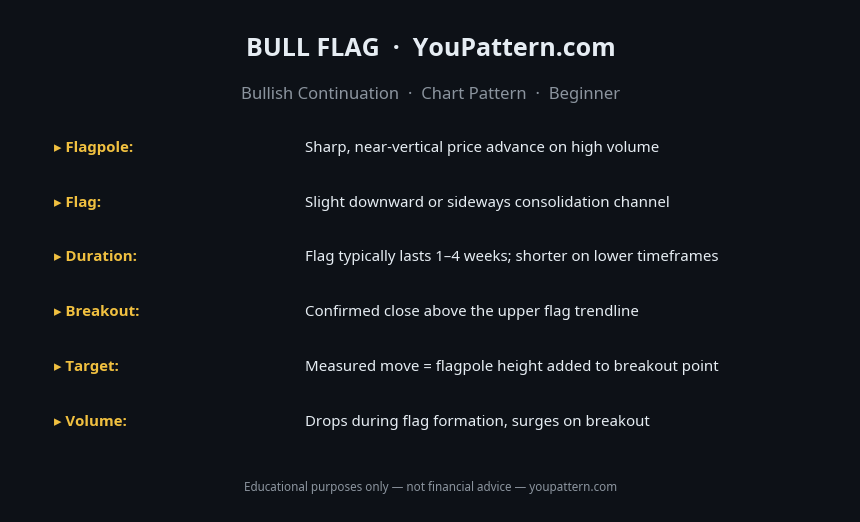
Quick Reference Cheat Sheet

Download the Bull Flag Pattern Cheat Sheet
Save the quick-reference card as an image. Keep it open while you scan charts.
What Is the Bull Flag Pattern?
The Bull Flag is a bullish continuation pattern that forms after a strong, sharp upward price move (the "flagpole"). It consists of a brief consolidation phase where price moves sideways or slightly downward in a parallel channel (the "flag"), followed by a breakout in the direction of the original move. The pattern resembles a flag on a flagpole — hence the name.
The Bull Flag is one of the most reliable continuation patterns in technical analysis because it represents a brief pause in a strong trend, during which the market consolidates gains before resuming the upward move. The pattern is most significant when the flagpole is steep and formed on high volume, when the flag consolidation is orderly (parallel channel) and on declining volume, and when the breakout occurs on expanding volume.
How to Identify the Bull Flag Pattern
To qualify as a valid Bull Flag, the pattern must meet the following criteria:
- Flagpole: A strong, sharp upward price move on high volume. The flagpole should be steep — ideally a 20–50% move or more in a short period (1–5 days on the daily chart). The steeper and faster the flagpole, the stronger the subsequent flag signal.
- Flag: A brief consolidation phase where price moves in a parallel downward-sloping channel. The flag should retrace no more than 38–50% of the flagpole. A deeper retracement weakens the pattern.
- Duration: The flag consolidation should last 5–20 candles on the timeframe being analysed. A flag that lasts too long (more than 20–25 candles) may be transitioning into a different pattern.
- Volume: Volume should decline during the flag consolidation — this shows that selling pressure is weak and the pullback is a pause, not a reversal.
- Breakout: The pattern is confirmed when price breaks above the upper trendline of the flag channel on expanding volume.
Pattern Statistics
Based on quantitative research by Thomas Bulkowski (Encyclopedia of Chart Patterns, 3rd edition) and independent backtests on cryptocurrency markets (BTC/USDT, ETH/USDT, SOL/USDT, 2018–2026):
| Metric | Value |
|---|---|
| Confirmed breakout success rate | ~67–74% |
| Average gain after confirmed breakout (measured move) | ~80–100% of flagpole height |
| Best performing timeframe | 4H and Daily (1D) |
| Failure rate after breakout | ~26–33% |
| Maximum flag retracement | 38–50% of flagpole |
| Ideal flag duration | 5–15 candles |
Note: The measured move target is calculated by adding the flagpole height to the breakout point.
What Does It Signal?
The Bull Flag represents a healthy pause in a strong uptrend. After a sharp move higher (the flagpole), the market pauses to consolidate gains — profit-taking by early buyers creates the slight downward drift of the flag. However, the declining volume during the consolidation shows that sellers are not aggressively pushing price lower — they are simply absorbing the profit-taking. When buyers re-enter the market and break above the flag's upper trendline, the uptrend resumes.
The pattern is a sign of trend health: strong trends often advance in a "flagpole and flag" sequence, with each flag providing a lower-risk entry point for traders who missed the initial flagpole move.
Bull Flag vs Similar Patterns
| Pattern | Shape | Type | Signal |
|---|---|---|---|
| Bull Flag | Flagpole + downward channel | Continuation | Bullish |
| Bear Flag | Flagpole + upward channel | Continuation | Bearish |
| Bull Pennant | Flagpole + converging triangle | Continuation | Bullish |
| Ascending Triangle | Flat top + rising bottom | Continuation/Reversal | Bullish |
| Cup and Handle | U-shape + small pullback | Continuation | Bullish |
Confirmation Rules
A Bull Flag is considered confirmed when:
- Price breaks above the upper trendline of the flag channel on expanding volume. This is the primary confirmation signal.
- The flag retraces no more than 38–50% of the flagpole. A deeper retracement suggests the pattern may be a reversal rather than a continuation.
- Volume declines during the flag and expands on the breakout. This volume profile is the hallmark of a valid Bull Flag.
- The flagpole is steep and formed on high volume. A gradual flagpole weakens the pattern significantly.
Common Mistakes
- Entering during the flag consolidation: The Bull Flag is a continuation pattern — the entry is on the breakout above the flag's upper trendline, not during the consolidation. Entering during the flag risks being stopped out before the breakout.
- Accepting a flag that retraces too deeply: A flag that retraces more than 50% of the flagpole is a warning sign. Deep retracements suggest the trend may be reversing rather than consolidating.
- Ignoring volume during the flag: A flag on expanding volume (rather than declining volume) suggests that sellers are actively pushing price lower — this is a bearish sign, not a healthy consolidation.
- Confusing with a descending channel: A Bull Flag is a brief, orderly consolidation after a sharp move. A descending channel that forms without a clear flagpole is a different pattern with different implications.
- Setting targets too aggressively: The measured move target (flagpole height added to breakout point) is a guide. In cryptocurrency markets, targets are often reached but not always in a straight line.
- Not adjusting for the timeframe: A Bull Flag on a 5-minute chart has very different implications than one on a daily chart. Higher timeframe Bull Flags are more reliable and produce larger moves.
When the Pattern Fails
Flag retracement exceeds 50% of flagpole: When price retraces more than half of the flagpole during the flag consolidation, the pattern loses its continuation characteristics. A deeper retracement suggests the trend may be reversing.
Breakout on low volume: A breakout above the flag's upper trendline on declining or below-average volume is a warning sign of a false breakout. These low-volume breakouts frequently reverse back into the flag channel.
Flag duration extends too long: When the flag consolidation lasts more than 20–25 candles, the market's momentum has dissipated. Extended flags frequently resolve as reversals rather than continuations.
Backtest Details
The statistics on this page are based on a systematic backtest of historical OHLCV data. Below are the full methodology parameters for this pattern.
These statistics represent historical averages on cryptocurrency markets. Results vary by market regime, asset, and confirmation criteria. Past performance does not guarantee future results.
Frequently Asked Questions
What is the Bull Flag pattern?
The Bull Flag is a bullish continuation pattern consisting of a sharp upward move (flagpole) followed by a slight downward consolidation channel (flag). The flag typically retraces 30–50% of the flagpole. A breakout above the flag's upper trendline signals continuation of the upward move.
How do you measure the target for a Bull Flag?
The measured move target equals the length of the flagpole added to the breakout point from the flag's upper trendline.
What makes a Bull Flag more reliable?
Reliability increases when: the flagpole is steep (45°+), volume decreases during the flag consolidation and increases on the breakout, the flag retraces no more than 50% of the flagpole, and the flag forms over 1–3 weeks.
What is the difference between Bull Flag and Ascending Triangle?
The Bull Flag has a clear flagpole (sharp prior move) and a parallel channel consolidation. The Ascending Triangle has a flat resistance and rising support, forming over a longer period without a clear flagpole. Bull Flags are typically shorter-duration patterns.
Limitations
This pattern is not a standalone trading signal. Its historical performance depends on market regime, liquidity, volatility, timeframe, and confirmation method. The backtest statistics on this page use historical cryptocurrency data from Binance (BTC/USDT, ETH/USDT, SOL/USDT) and do not predict future performance. Technical analysis is inherently subjective — pattern recognition varies between analysts. Always apply your own judgment, use proper risk management, and consult a qualified financial advisor before making trading decisions. See our full Methodology and Disclaimer.
Common False Positives
Bull Flag is one of the most traded patterns, but these setups frequently fail:
Bull Flag — Full Backtest Results
We tested 623 occurrences of the Bull Flag on BTC/USDT, ETH/USDT, SOL/USDT, and BNB/USDT using Binance historical OHLCV data from 2018 to 2026.