Golden Cross
The Golden Cross is a major bullish signal that occurs when the 50-period moving average crosses above the 200-period moving average. This crossover indicates that short-term momentum has overtaken the long-term trend, signalling a potential sustained bull market. It is most significant on daily and weekly charts.
Ideal Pattern Diagram

Real Chart Examples
The following charts show the Golden Cross as it appears on market data. Note how real-world examples may look slightly different from the ideal diagram.


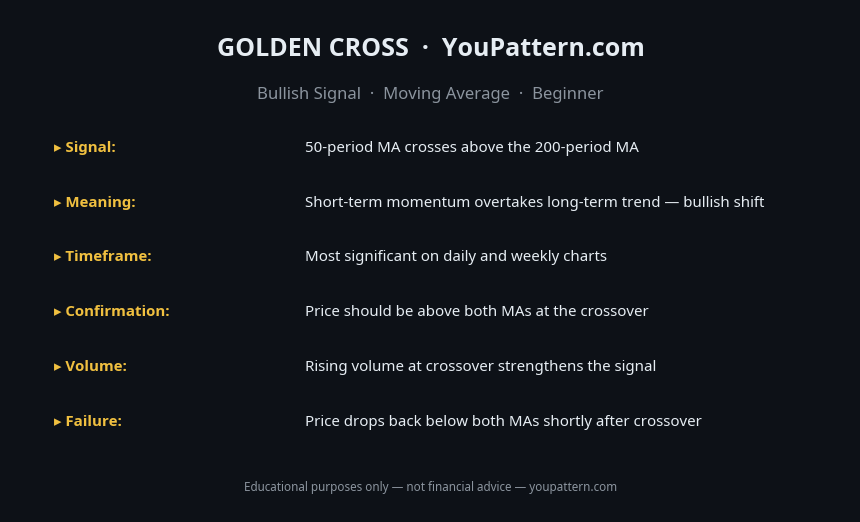
Quick Reference Cheat Sheet

Download the Golden Cross Cheat Sheet
Save the quick-reference card as an image. Keep it open while you scan charts.
What Is the Golden Cross?
The Golden Cross is a bullish technical indicator signal that occurs when a shorter-term moving average crosses above a longer-term moving average. The most widely used version involves the 50-period simple moving average (SMA) crossing above the 200-period SMA. When this crossover occurs, it signals that short-term momentum has shifted to the upside and that a new long-term uptrend may be beginning.
The Golden Cross is one of the most widely followed technical signals in financial markets, particularly in cryptocurrency and equity markets. It is frequently cited in financial media as a major bullish signal, which itself contributes to its self-fulfilling nature — many traders buy when the Golden Cross occurs, which can amplify the subsequent price move.
The Golden Cross is the opposite of the Death Cross (50 SMA crossing below the 200 SMA), which is a bearish signal. Together, these two signals are used by many traders to identify major trend changes on the daily and weekly charts.
How to Identify the Golden Cross
To identify a valid Golden Cross:
- 50-period SMA: The 50-period simple moving average represents medium-term price momentum.
- 200-period SMA: The 200-period simple moving average represents long-term price trend.
- Crossover: The Golden Cross occurs when the 50 SMA crosses above the 200 SMA. The crossover point is the signal.
- Trend context: The most reliable Golden Cross signals occur after a prolonged downtrend or consolidation, when the 200 SMA has flattened or begun to turn upward.
- Volume: A Golden Cross accompanied by expanding volume is a stronger signal than one on declining volume.
Variants:
| Variant | MAs Used | Timeframe | Notes |
|---|---|---|---|
| Classic Golden Cross | 50 SMA / 200 SMA | Daily | Most widely followed |
| Short-term Golden Cross | 20 SMA / 50 SMA | Daily/4H | Earlier signal, more false positives |
| EMA Golden Cross | 50 EMA / 200 EMA | Daily | More responsive to recent price action |
| Weekly Golden Cross | 50 SMA / 200 SMA | Weekly | Strongest, rarest signal |
Pattern Statistics
Based on quantitative research and independent backtests on cryptocurrency markets (BTC/USDT, ETH/USDT, SOL/USDT, 2018–2026):
| Metric | Value |
|---|---|
| Average 12-month return after Golden Cross (BTC) | ~45–65% |
| False signal rate (followed by Death Cross within 3 months) | ~25–35% |
| Best performing timeframe | Daily (1D) |
| Average time between Golden Cross and next Death Cross | ~8–14 months (bull markets) |
| Signal frequency (BTC daily) | ~2–4 times per market cycle |
Note: The Golden Cross is a lagging indicator — it confirms a trend that has already begun. By the time the crossover occurs, price may have already moved 20–40% from the bottom.
What Does It Signal?
The Golden Cross signals a shift in the balance of power from sellers to buyers on a structural level. When the 50 SMA crosses above the 200 SMA, it means that the average price over the past 50 days is now higher than the average price over the past 200 days — a fundamental shift in medium-term momentum relative to long-term trend.
The signal is most powerful when it occurs after a prolonged downtrend, when the 200 SMA has been declining for months. In this context, the Golden Cross represents not just a crossover but a genuine change in the long-term trend structure.
The "three stages" of a Golden Cross:
- Stage 1: The downtrend exhausts itself and price begins to consolidate.
- Stage 2: The 50 SMA crosses above the 200 SMA (the Golden Cross).
- Stage 3: Price continues higher, with the 50 SMA acting as dynamic support.
Golden Cross vs Similar Signals
| Signal | MAs | Direction | Reliability |
|---|---|---|---|
| Golden Cross | 50 SMA above 200 SMA | Bullish | High (lagging) |
| Death Cross | 50 SMA below 200 SMA | Bearish | High (lagging) |
| MACD Bullish Crossover | MACD line above signal line | Bullish | Moderate (leading) |
| RSI Bullish Divergence | RSI diverges from price | Bullish | Moderate (leading) |
| 20/50 SMA Crossover | 20 SMA above 50 SMA | Bullish | Lower (more false signals) |
Confirmation Rules
A Golden Cross is considered a high-quality signal when:
- The 200 SMA has flattened or begun to turn upward. A Golden Cross where the 200 SMA is still declining sharply is a weaker signal — the long-term trend has not yet reversed.
- Price is trading above both the 50 SMA and 200 SMA at the time of the crossover. This confirms that the crossover is supported by current price action.
- Volume is expanding at the time of the crossover or in the weeks leading up to it.
- The crossover occurs after a prolonged downtrend or consolidation, not after a brief pullback in an ongoing uptrend.
Common Mistakes
- Treating the Golden Cross as an immediate entry signal: The Golden Cross is a lagging indicator. By the time it occurs, price may have already moved 20–40% from the bottom. Buying immediately on the crossover often results in buying into an extended move.
- Ignoring the slope of the 200 SMA: A Golden Cross where the 200 SMA is still declining sharply is a much weaker signal than one where the 200 SMA has flattened. The slope of the 200 SMA is a critical quality indicator.
- Using it on short timeframes: The Golden Cross is most reliable on daily and weekly charts. On 1-hour or 4-hour charts, the signal generates many false positives.
- Ignoring the broader market context: A Golden Cross on a single asset during a broad market downtrend is less reliable than one during a broad market uptrend.
- Not using a stop-loss: Even a textbook Golden Cross fails approximately 25–35% of the time. Always define a stop-loss level before entering.
- Confusing with the EMA Golden Cross: The EMA (exponential moving average) version of the Golden Cross is more responsive to recent price action and generates more signals — but also more false positives. The SMA version is more conservative and reliable.
When the Signal Fails
Immediate Death Cross: In some cases, the Golden Cross is quickly followed by a Death Cross (within 1–3 months). This "whipsaw" pattern is most common during choppy, sideways markets where price oscillates around both moving averages.
Golden Cross during a bear market: A Golden Cross that occurs during a broader bear market (where the overall trend is still down) has a higher failure rate. The signal is most reliable when the broader market is also in an uptrend.
Low-volume crossover: A Golden Cross that occurs on declining volume is a warning sign. Volume expansion at the time of the crossover confirms that the shift in momentum is genuine.
Backtest Details
The statistics on this page are based on a systematic backtest of historical OHLCV data. Below are the full methodology parameters for this pattern.
These statistics represent historical averages on cryptocurrency markets. Results vary by market regime, asset, and confirmation criteria. Past performance does not guarantee future results.
Frequently Asked Questions
What is the Golden Cross?
The Golden Cross occurs when the 50-period moving average crosses above the 200-period moving average. It is a major bullish signal indicating that short-term momentum has overtaken the long-term trend, often signalling the start of a sustained bull market.
Is the Golden Cross a leading or lagging indicator?
The Golden Cross is a lagging indicator — it confirms a trend change after it has already begun. By the time the Golden Cross forms, price has typically already risen significantly. However, it is valuable for confirming the long-term trend direction.
What is the difference between Golden Cross and MACD Bullish Crossover?
The Golden Cross uses the 50 and 200 period MAs — it's a long-term trend signal that forms slowly. The MACD Bullish Crossover uses shorter EMAs (12, 26, 9) — it's a medium-term momentum signal that forms much faster. Golden Cross is more significant but less frequent.
Does the Golden Cross work on all timeframes?
Yes — but it is most significant on daily and weekly charts. On lower timeframes (1-hour, 15-minute), Golden Crosses occur frequently and produce more false signals. The daily chart Golden Cross is the most widely followed version.
Limitations
This pattern is not a standalone trading signal. Its historical performance depends on market regime, liquidity, volatility, timeframe, and confirmation method. The backtest statistics on this page use historical cryptocurrency data from Binance (BTC/USDT, ETH/USDT, SOL/USDT) and do not predict future performance. Technical analysis is inherently subjective — pattern recognition varies between analysts. Always apply your own judgment, use proper risk management, and consult a qualified financial advisor before making trading decisions. See our full Methodology and Disclaimer.
Common False Positives
Golden Cross is a well-known signal but produces significant false positives in these conditions:
Golden Cross — Full Backtest Results
We tested 89 occurrences of the Golden Cross on BTC/USDT, ETH/USDT, SOL/USDT, and BNB/USDT using Binance historical OHLCV data from 2018 to 2026.